Emerald Ash Borer (EAB) is one of the most destructive invasive tree pests in North America. If you own an ash tree in Colorado Springs, Fountain, Monument, Pueblo, Castle Rock, Ellicott, or surrounding areas, now is the time to understand the threat and your options for protecting your trees.
At Gilbert's Tree Service, we've been providing professional tree care and landscaping services for more than 30 years. We help Colorado property owners maintain healthy, safe, and beautiful landscapes — including evaluating ash trees threatened by Emerald Ash Borer.
What Is Emerald Ash Borer?
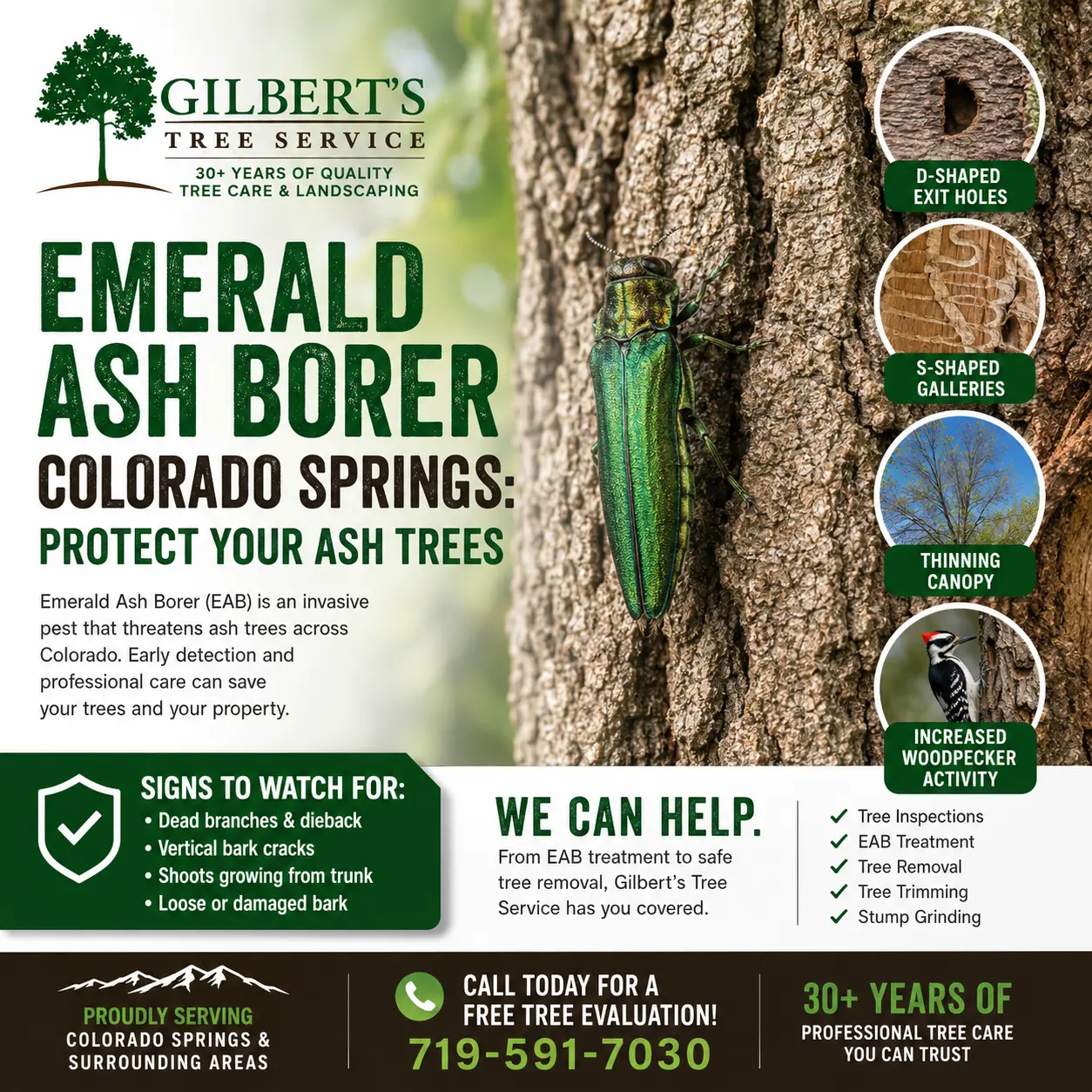
Emerald Ash Borer (Agrilus planipennis) is a small metallic-green beetle that attacks ash trees. The larvae tunnel beneath the bark and feed on the tissues responsible for transporting water and nutrients throughout the tree. Over time, this damage causes canopy thinning, branch dieback, structural deterioration, and eventually tree death.
EAB was discovered in Colorado in 2013 and has since spread through portions of the Colorado Front Range. While its spread in Colorado has been slower than in many eastern states, ash trees remain at risk — making early detection and professional tree care especially important.
Signs of Emerald Ash Borer
Knowing what to look for can help you identify a problem before your ash tree becomes a serious hazard. Common EAB symptoms include:
- Small, D-shaped exit holes in the bark
- Thinning leaves and canopy
- Dead branches, especially near the top
- Vertical bark cracks
- Excessive shoots growing from the trunk
- S-shaped galleries beneath the bark
- Increased woodpecker activity
- Progressive canopy decline
- Loose or damaged bark
Not every declining ash tree has EAB. Drought, disease, root problems, and environmental stress can cause similar symptoms. A professional tree inspection helps determine the actual cause.
Can Emerald Ash Borer Kill a Healthy Ash Tree?
Yes. EAB can attack healthy ash trees and gradually disrupt their ability to move water and nutrients. However, homeowners should not automatically remove every ash tree because EAB is a threat.
A healthy, structurally sound ash tree may be a candidate for preventative Emerald Ash Borer treatment. A severely declining or hazardous tree may be better removed. The right decision depends on the tree's health, size, location, structural condition, and landscape value.
Emerald Ash Borer Treatment in Colorado Springs
Professional EAB treatment may help protect appropriate ash trees from this destructive pest. Treatment may be worth considering when an ash tree:
- Is healthy or only moderately affected
- Provides significant shade
- Is mature and difficult to replace
- Has substantial landscape value
- Is structurally sound
- Is located where removal would be difficult or expensive
Treatment is not appropriate for every tree. Severely declining trees may have too much damage to justify continued treatment. A professional evaluation can help determine whether ash tree treatment, pruning, monitoring, or removal is the best option.
When Should an Ash Tree Be Removed?
Unfortunately, some ash trees cannot be saved. Removal may be necessary when a tree has:
- Extensive canopy dieback
- Large dead or weakened branches
- Significant trunk damage or major cracks
- Severe structural defects
- Root problems
- Become a safety hazard
Location matters too. A declining ash tree near a house, garage, driveway, sidewalk, fence, vehicle, or utility line poses a much greater risk. Don't wait until a dead tree becomes an emergency.
Ash Tree Removal in Colorado Springs
Professional ash tree removal eliminates hazards and gives homeowners an opportunity to replace a declining tree with a species better suited to their landscape. When replacing an ash tree, consider the available space, soil, sunlight, water requirements, mature size, and Colorado growing conditions.
Tree diversity is also important. Replacing every ash with the same species can create future problems if another pest or disease targets that tree.
What Should You Do If You Suspect EAB?
If your ash tree is declining, don't wait until it is dead. Look for unusual canopy thinning, dead branches, bark damage, D-shaped holes, or increased woodpecker activity — then have the tree professionally evaluated. Depending on the tree's condition, your options may include:
- Preventative EAB treatment
- Ongoing monitoring
- Professional pruning
- Deadwood removal
- Hazard assessment
- Ash tree removal
- Replacement tree planting
Early evaluation gives you more choices.
Frequently Asked Questions
Is Emerald Ash Borer in Colorado?
Yes. EAB was discovered in Colorado in 2013 and has spread through portions of the Colorado Front Range.
What are the signs of Emerald Ash Borer?
Common signs include D-shaped exit holes, canopy thinning, dead branches, bark cracks, trunk shoots, woodpecker activity, and S-shaped galleries beneath the bark.
Can an ash tree be saved from Emerald Ash Borer?
Some healthy and moderately affected trees may be candidates for professional treatment. Severely declining trees may require removal.
Should I remove my ash tree?
Not necessarily. A healthy, structurally sound tree may be worth protecting. A dead, severely declining, or hazardous tree may need removal.
How much does ash tree removal cost in Colorado Springs?
Cost varies based on tree size, height, location, accessibility, condition, nearby structures, equipment, and disposal requirements. A professional estimate is the best way to determine the cost.
Who should inspect my ash tree?
A qualified tree-care professional can evaluate your tree and help determine whether treatment, pruning, monitoring, or removal is appropriate.
Trust Gilbert's Tree Service for Colorado Tree Care
For more than 30 years, Gilbert's Tree Service has helped homeowners and property owners care for their trees and landscapes. If you're concerned about Emerald Ash Borer in Colorado Springs, our team can help evaluate your ash tree and discuss your options.
Whether your tree needs Emerald Ash Borer treatment, tree trimming, tree removal, or long-term maintenance, we can help you determine the best course of action. Don't wait until your ash tree becomes a hazard. Contact Gilbert's Tree Service today to schedule a professional tree evaluation, or call (719) 683-3437.